Golf has one of the strangest reputations in sports.
Some people still treat it like barely-exercise. Others act like spending five hours on a golf course automatically counts as peak fitness. Honestly, both views miss what golf actually does to the body over time.
I used to underestimate the physical side of golf too. Then I tracked a full round on my watch and realized I had walked farther than I normally do during a standard workday. On hillier courses especially, my legs felt surprisingly heavy by the back nine. Not exhausted exactly. Just steadily drained in a way that sneaks up on you.
But there’s another side to that experience golf culture rarely talks about.
A lot of regular golfers are also dealing with:
- stiff lower backs
- tight hips
- sore wrists
- irritated elbows
- shoulders that feel strangely locked up the next morning
And many of them simply accept that discomfort as part of the sport.
That contradiction is what makes golf physically interesting.
Golf absolutely can keep people active. Walking uneven terrain for several hours creates meaningful movement, especially for adults who would otherwise spend weekends sitting indoors. At the same time, repetitive rotational stress combined with aging joints and poor mobility can slowly wear the body down in ways many golfers do not notice until pain becomes consistent.
So yes, golf can help keep your body fit.
But the way you play matters much more than most health articles admit.

Why does golf cause lower back pain?
Golf causes lower back pain primarily due to lumbar compensation for poor hip and thoracic mobility. When a golfer’s hips and upper back lack the necessary rotational flexibility, the body forces the stable lumbar spine to rotate aggressively during the swing, placing destructive shear force on the spinal discs.
| The Variable | The Healthy Approach (Walking) | The High-Risk Approach (Cold-Start Cart) |
|---|---|---|
| Spinal Loading | Continuous low-level walking keeps muscles warm and lubricated. | Sitting static in a cart, followed by sudden, violent maximal rotation. |
| Caloric Burn | Estimated 1,200–1,500 calories burned over 18 holes. | Estimated 500–600 calories burned due to minimal movement. |
| Cardio Profile | Sustained Zone 1/2 aerobic zone (4–5 miles of tracking). | Spiky, irregular stress heart-rates without aerobic adaptation. |
Golf Creates a Strange Kind of Fatigue
One reason people overestimate the fitness side of golf is because the game leaves you feeling genuinely tired afterward.
But it’s not always traditional workout fatigue.
Golf creates this weird mix of:
- mental exhaustion
- low-level physical strain
- dehydration
- prolonged concentration
- repetitive movement
For four or five hours, you’re constantly making decisions:
- adjusting club selection
- reading terrain
- recalculating distances
- controlling frustration
- resetting focus after bad shots
That cognitive load drains energy even when your heart rate never stays particularly elevated for long stretches.
I’ve noticed this especially after slower rounds where the physical intensity stayed fairly moderate, yet mentally I still felt completely cooked afterward. The body and brain interpret that accumulated fatigue as “serious exercise,” even when the cardiovascular demand may not fully match the feeling.
That’s part of why golf confuses people fitness-wise.
It feels physically bigger than it sometimes is.
At the same time, walking a course for several hours still creates real movement volume. Especially for amateur golfers who spend half the round wandering sideways looking for slightly terrible tee shots in rough grass.
Most golfers walk farther than they think.

Why Golf Injuries Usually Start in the Hips — Not the Back
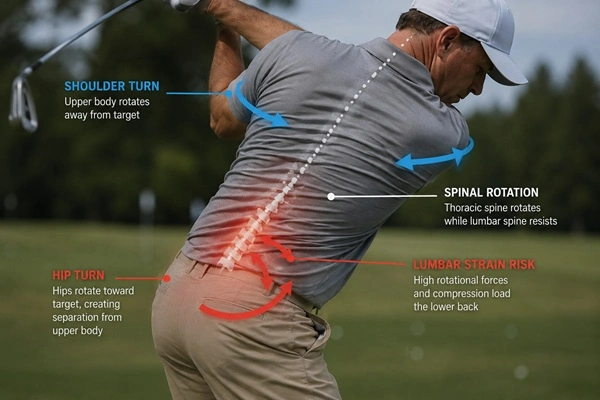
Most golfers blame the lower back when pain shows up, but the problem often starts somewhere else entirely.
A healthy golf swing depends heavily on hip rotation and thoracic spine mobility. When those areas stop moving efficiently, the lumbar spine starts absorbing rotational force it was never designed to handle repeatedly.
That’s where problems begin building quietly.
The lower back is built more for stability than aggressive rotation. But many recreational golfers gradually lose hip internal rotation as they age, especially if most of their daily life involves sitting. Instead of rotating cleanly through the hips and mid-back, they begin twisting excessively through the lumbar spine during the downswing.
The body always finds motion somewhere. Even when it finds it in the wrong place.
I started noticing this pattern at driving ranges years ago. The stiffest golfers often swing the hardest. Some can barely separate upper-body rotation from lower-body movement, so the lower back ends up compensating aggressively during impact.
The problem is that compensation does not always hurt immediately.
A single round might feel fine. But repeated hundreds of swings over months and years, the stress slowly accumulates.
That’s why many golfers describe oddly specific pain patterns:
- Tightness on one side of the lower spine
- Soreness getting out of the car afterward
- Stiffness the morning after a round
- Pain during rotation rather than walking
Those symptoms often point toward rotational overload more than simple muscle soreness.
The Real-World Cause:
Think of your body during a swing like a three-part chain: your hips twist, your upper back twists, and your lower back holds everything steady.
When a week of sitting at a desk locks up your hips and glutes, they stop turning. But your brain still wants a full golf swing, so it forces your lower back to do the twisting instead. Because your lower back isn’t built to twist like a corkscrew, repeating this movement weekend after weekend is what eventually causes severe stiffness and muscle spasms.
The Real Physical Difference Between Walking and Riding

Most golf articles reduce this discussion to calories burned. Honestly, that’s the least interesting part.
The bigger difference is movement variability.
Walking a course forces the body to constantly adapt:
- uneven terrain
- balance changes
- sidehill lies
- stabilizer muscle engagement
- subtle posture adjustments
- repeated deceleration and acceleration
Your body keeps making small physical corrections for several hours.
Cart golf removes a surprising amount of that variability. You spend more time transitioning abruptly from sitting still to explosive rotation. For golfers already dealing with stiffness or mobility restrictions, that stop-start pattern can actually make the body feel tighter afterward.
I noticed this myself after alternating between walking rounds and cart rounds over several weeks. Walking rounds left me generally fatigued. Cart rounds left me stiff.
That difference surprised me more than the calorie burn numbers ever did.
Walking also changes pacing naturally. Players usually swing with more rhythm because movement stays continuous between shots instead of repeatedly jumping from seated rest into rotational force.
That matters biomechanically.
The body generally tolerates repetitive movement better when motion stays fluid instead of constantly interrupted.
This nuance rarely gets discussed in generic golf fitness content because “walking burns more calories” is simpler to explain. But mechanically, movement quality may matter more long-term than calorie estimates alone.
Golf After 40 Feels Completely Different
Most golf fitness articles quietly write as if every golfer is 28 years old with perfect mobility.
Reality looks different.
After 40, recovery changes noticeably for many players:
- hips tighten faster
- thoracic rotation decreases
- warm-ups suddenly matter
- lower-back stiffness lasts longer
- mobility limitations show up more clearly during swings
At the same time, golf may actually become more valuable physically with age because it encourages sustainable movement without the impact levels of harder sports.
I’ve played with older golfers who move slower between holes yet stay more physically capable overall than younger sedentary players. Some of them walk multiple rounds every week well into their 60s and 70s because golf gives them a reason to keep moving consistently.
That’s probably golf’s biggest fitness advantage.
Not transformation.
Not athletic explosiveness.
Not dramatic body changes.
Longevity.
Golf works best as a long-term movement habit people genuinely maintain for decades.
And honestly, that may matter more than extreme workout intensity for most adults.
What Golf Actually Does Well — And What It Doesn’t
| What Golf Excels At | What Golf Fails to Provide |
|---|---|
| Long-Term Movement Consistency | Building serious lean muscle mass |
| Low-Impact Joint Conditioning | High-intensity VO2 Max cardiovascular cardio |
| Mobility Maintenance for Older Adults | Rapid fat loss without supplementary caloric deficits |
| Social & Cognitive Engagement | Symmetrical full-body strength development |
This is where many golf health articles become unrealistic.
Golf is not a complete fitness system.
Someone relying only on golf will probably still benefit from:
- strength training
- mobility work
- core stability exercises
- flexibility training
But compared to doing nothing?
Golf wins easily.
Especially when walking becomes part of the routine consistently.
How To Make Golf Easier on Your Body
A few small changes dramatically improve how golf feels physically long term.
- Execute a simple 3-minute warmup at the first tee:
Skipping a warmup ensures your muscles are cold and stiff when you ask them to rotate at high speeds. Try this quick, easy routine behind your cart before hitting your first shot:• Club-Supported Hip Swings (60 seconds): Hold your driver flat against the ground in front of you for balance. Stand on one leg and smoothly swing your opposite leg side-to-side to loosen up your hip joints.• Shoulder-To-Shoulder Turns (60 seconds): Place your driver across the back of your shoulders behind your neck. Get into your normal golf stance, bend forward slightly, and gently turn your torso back and forth while keeping your belt buckle facing straight ahead.• Bodyweight Squats (60 seconds): Do 10 slow, easy squats. This wakes up the large muscles in your legs and glutes so your lower back doesn’t have to pull double duty during your downswing. - Stop overswinging constantly:
Trying to absolutely murder every single drive usually creates massive physical strain for very little actual extra distance. Focus on a controlled, smooth rhythm instead of maximum power. - Walk more rounds when possible:
This isn’t just about burning calories. Continuous walking keeps your body moving fluidly between shots, which naturally keeps your muscles warm and loose. Sitting static in a cart for ten minutes and then jumping out to swing hard is much tougher on your joints. - Pay attention to recurring stiffness:
Deep soreness or tightness that repeatedly shows up the morning after 18 holes is useful feedback from your body. It’s usually a warning sign that you’re compensating for a lack of mobility, not just a normal penalty for getting older.
So, Can Golf Keep Your Body Fit?
Yes.
But not automatically.
Golf works best when people treat it like actual physical activity instead of a passive leisure event where movement barely matters. Walking consistently, maintaining mobility, and understanding how rotational stress affects the body changes the health equation completely.
At the same time, golf is not magically safe simply because it looks calm from the outside.
Poor mobility, repetitive compensation patterns, weak core stability, and years of aggressive swinging can quietly turn golf into a reliable source of chronic stiffness if people ignore what their body is telling them.
That’s probably the most honest answer.
The Final Takeaway:
The healthiest golfers usually are not the ones trying to swing the hardest. They’re the ones still comfortably walking courses twenty years later without their back screaming at them afterward.